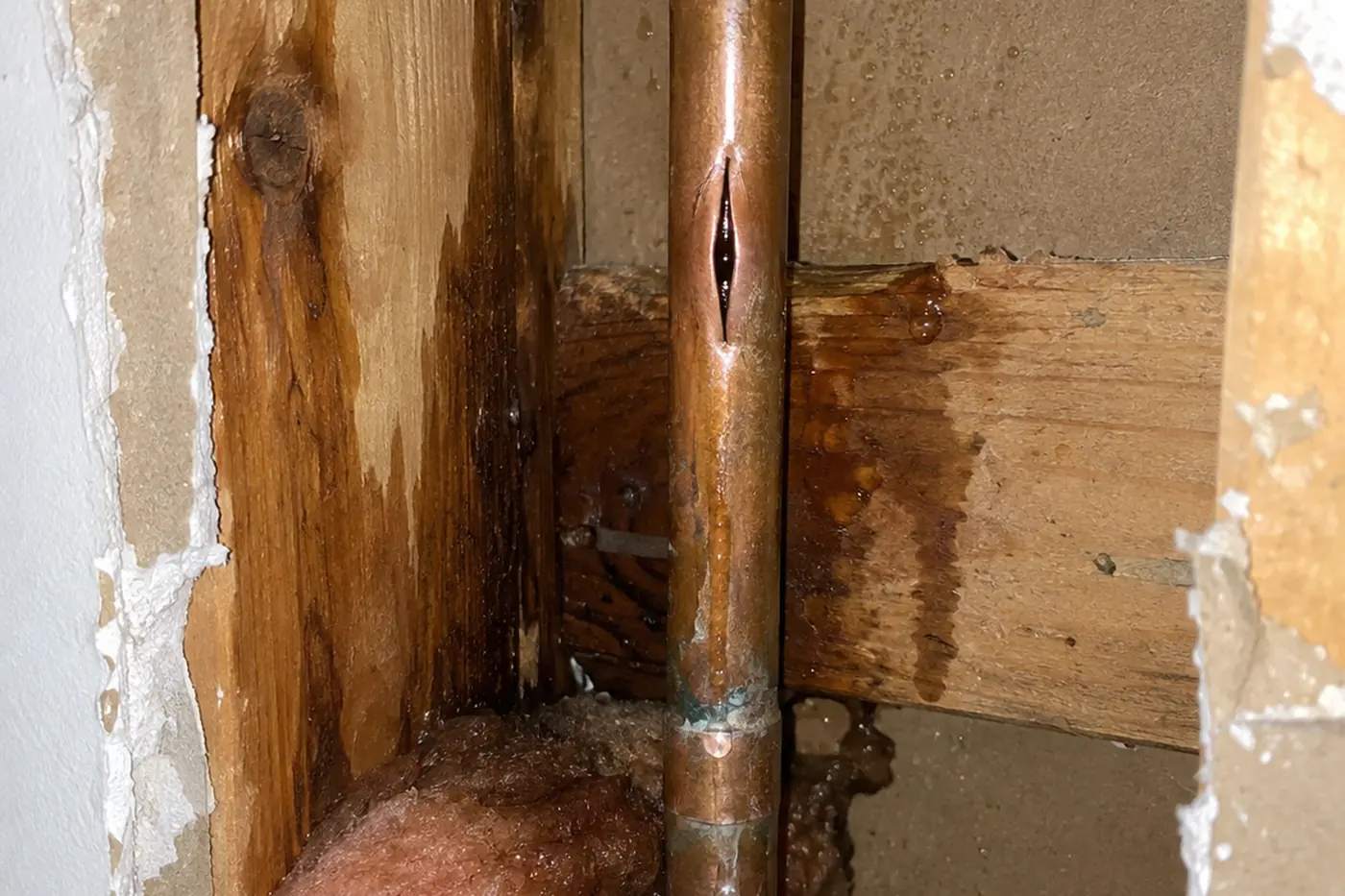
A failed supply line puts out water continuously until someone shuts the main. What it soaks in that time is rarely limited to the room you found it in.
(864) 515-4097 Call nowWater damage gets more expensive by the hour. Lines are answered at any time, including nights, weekends and holidays.
(864) 515-4097Useful to have ready, though none of it is required:
Burst pipes are the most commonly covered water loss on a homeowners policy, because they are sudden and accidental in exactly the way policies describe. They are also the loss most likely to be underestimated, because a supply line runs at pressure and keeps running until the main is closed.
A line that failed at two in the morning and was found at seven has put water into the building for five hours. That water is not sitting where the pipe is. It has run along the top plate, down inside the cavity, across the subfloor under the finish flooring, and frequently into the room below or the crawl space beneath.
Inside a wall, water runs down the back of the drywall and collects at the bottom plate, where it sits against framing and wicks upward into material that looks untouched from the room. Under a floor, it spreads along the subfloor and finds the low point, which is often nowhere near the leak.
This is why the first thing done after extraction is a moisture map rather than demolition. Cutting drywall in the wrong place costs you a repair you did not need. Not cutting it where water actually sat costs you a mold claim later.
Sudden supply line failures are usually covered. What causes trouble is not the cause but the evidence: policies generally oblige you to mitigate promptly, and adjusters ask what was wet before drying started. If nobody measured, that conversation becomes an argument.
Readings are taken and photographed on arrival, then daily until the structure reads dry, and handed over as a log with the scope of work. That record is the difference between a claim that settles and one that drags.
Braided washing machine hoses are the classic one, typically failing after five to seven years and usually when nobody is home. Water heater tanks fail at the base and empty their full capacity. Refrigerator ice maker lines leak slowly behind a cabinet for weeks before anyone notices. Toilet supply lines and shutoff valves fail quietly. In older housing near downtown, aging galvanised and copper lines inside walls are the recurring cause.
Calling costs nothing, and you will get an honest answer about the need for a crew and what you can safely handle yourself.
(864) 515-4097Usually yes, because it is sudden and accidental. What is generally excluded is gradual seepage from a leak that ran for weeks or months, and groundwater flooding, which needs separate flood coverage. Read your policy and check with your carrier, since coverage varies.
Shut the water off yourself at the main if you can reach it safely. Then call both. The plumber repairs the pipe. The restoration crew deals with the water already in the building. They are separate jobs and waiting for one before starting the other costs you drying time.
In this area it is usually at the meter near the street, or where the supply line enters the house, often in a crawl space or near the water heater. Find it now rather than during an emergency, and check the valve actually turns. Seized valves are common in older homes.
Only what is wet and cannot be dried in place, which the moisture readings determine. Often that is a cut of six to twelve inches above the floor along the affected wall. Sometimes nothing needs to come out at all if the cavity can be dried through the existing openings.