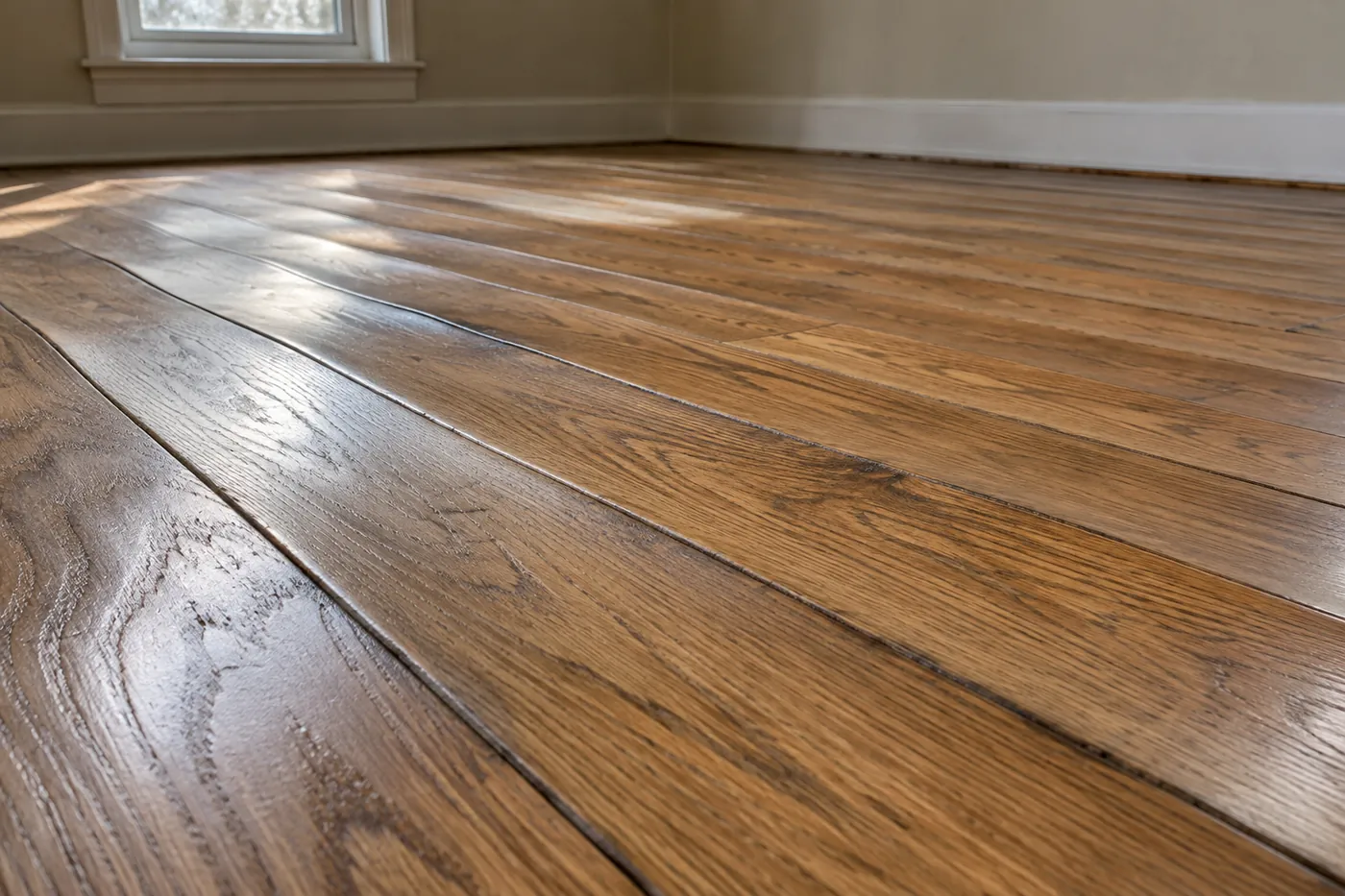
Most floors that end up torn out were savable on day one and lost somewhere between day three and the sanding date.
Wood is not a finished product. It is a material that keeps trading moisture with the air around it for as long as it exists. When water gets under it, the wood does exactly what it is supposed to do, and the shape it takes tells you what is happening underneath.
Every board is a bundle of hollow cells. They swell when they take on moisture and shrink when they give it up, and they do it far more across the width of the board than along its length. That difference is why a floor moves the way it does.
Your floor was installed at a moisture content in equilibrium with your house — typically somewhere between 6% and 9% in the Upstate. Get it wet and that number climbs. The part that gets wet first swells first, and because the board is fastened down on both sides, it cannot expand outward. So it deforms.
The direction of the deformation is the diagnosis. The USDA Forest Products Laboratory has published the underlying wood-moisture research for decades, and the National Wood Flooring Association publishes the installation and moisture standards that flooring contractors work from.
Run your hand across the boards. If the edges stand proud of the center and the floor feels like a washboard, that is cupping.
Cupping means the bottom of the board is wetter than the top. The underside swells, the top stays comparatively dry, and the board rolls upward at the edges.
Where the water came from, in order of how often we see it:
The important part: cupping is frequently reversible. If the floor dries evenly and slowly, the moisture equalizes across the board and it flattens back out. Not always fully, but often enough that tearing it out on day two is a mistake.
Crowning is cupping's mirror image: the middle of each board sits higher than the edges.
There are two ways to get there, and they are very different problems.
The wood dried from the top too fast. Heat or aggressive surface airflow pulls moisture out of the top face while the bottom is still wet. The top shrinks, the bottom does not, and the board rolls the other way.
Somebody sanded a cupped floor before it was dry. This is the big one, and it is covered in its own section below, because it is the single most expensive mistake in hardwood restoration.
Crowning is much harder to reverse than cupping. Sometimes it relaxes. Often it does not, and the floor needs to be replaced.
Buckling is when boards lift completely away from the subfloor, sometimes several inches, usually in a tented ridge across the room.
This happens when the floor has absorbed so much moisture that the expansion exceeds every bit of room the installer left at the perimeter. With nowhere left to go, the pressure releases upward and the fasteners let go.
Buckled sections do not come back. Those boards are removed. The question then becomes what condition the subfloor is in, which matters more than the boards did.
Here is the one thing worth taking away from this entire page.
Do not let anyone sand a cupped floor until it has reached equilibrium moisture content.
The logic is seductive. The floor is cupped, sanding makes it flat, so sand it flat. And it works — for a few weeks.
What actually happened is that the sander removed material from the high edges of a board that was temporarily deformed. When the board finishes drying and returns to its natural flat shape, the edges that were cut down are now lower than the center. The floor crowns. And it crowns permanently, because material is gone and it is not coming back.
Every legitimate wood flooring standard says the same thing: dry first, wait for the floor to stabilize, then assess. Then sand, if sanding is still needed. Frequently it is not.
The stabilization period is measured in weeks, not days. A floor can hit its target moisture reading and still need time for the moisture to distribute evenly through the thickness of each board. Rushing this step is how a savable floor becomes a replacement.
Ordinary air movers blowing across the surface of a hardwood floor do the opposite of what you want. They dry the top face fast, while the water is underneath. That is how you get crowning.
Proper hardwood drying works from below or through the assembly:
Mat drying systems. Sealed panels are laid on the floor surface and connected to a vacuum unit. They pull air down through the board seams and the floor assembly, drawing moisture out from underneath rather than off the top.
Injection drying. Air is forced into the space between the flooring and the subfloor, often through the baseboard line or through small holes, so it moves through the cavity where the water is.
Crawl space drying. When the source is below, the crawl space itself gets dried and dehumidified, which pulls moisture down and out of the subfloor from the underside.
Low humidity, not high heat. Desiccant dehumidification drives the surrounding air very dry so the wood gives up moisture steadily. Heat is deliberately controlled — excessive heat causes surface checking, which is fine cracking in the face of the board, and honeycombing, which is internal cell collapse. Both are permanent.
Expect 7 to 14 days, sometimes longer. Drywall dries in three to five. Hardwood is a different class of problem — see water damage Class 1 to 4 for why it is billed differently. Our structural drying page covers the equipment side.
Solid hardwood is the best candidate for saving. It is a single piece of wood, so it dries as one thing, and it has enough thickness to be sanded and refinished afterward if it needs it — often several times over its life.
Engineered hardwood is a real wood wear layer bonded to a plywood or HDF core. The wear layer is often 2 to 4 mm. It can be dried and it often survives, but two things limit it: the adhesive layers can delaminate when saturated, and there is very little material available for sanding. Once the wear layer separates from the core, the board is finished.
Laminate is not wood. It is a printed photographic layer over a fiberboard core. Fiberboard swells irreversibly when it gets wet, and the swelling shows as blown, crumbling edges. Laminate that has taken on water is removed, not dried. There is no restoration path.
Luxury vinyl plank is waterproof itself, which is exactly what makes it dangerous. The plank sheds water perfectly while trapping whatever got underneath it against the subfloor or slab. A LVP floor that looks fine can sit on top of a saturated subfloor for months. If water reached it, the floor comes up so the assembly underneath can be read.
Homeowners focus on the boards. The more important reading is usually the layer under them.
A plywood or OSB subfloor holds a lot of water and dries slowly. If it stays wet under a dried hardwood floor, three things follow: the hardwood will not stabilize because it keeps drawing moisture from below, the subfloor itself can delaminate, and the closed cavity is a favorable environment for microbial growth.
This is why a real assessment includes moisture readings of the subfloor, not just the surface. If nobody has taken a subfloor reading, nobody knows what the floor is sitting on.
OSB in particular gives a warning sign worth knowing: once it swells and the edges go soft and fibrous, it does not recover its thickness. That is a replacement condition regardless of how the hardwood above it reads.
A large share of Greenville County's older housing sits over a vented crawl space, and that produces a specific pattern worth recognizing.
Seasonal cupping with no leak anywhere.
Here is how it happens. In summer, outdoor air in the Upstate carries a dew point in the low 70s. Crawl space surfaces — the soil, the block, the underside of the subfloor — sit cooler than that because the ground keeps them down. Open foundation vents pull that humid air in, it hits cool surfaces, and the moisture condenses out onto your framing and subfloor.
The underside of your hardwood absorbs it. The top face, sitting in a conditioned room, does not. The floor cups. In winter the crawl space dries out and the cupping partly relaxes.
If your floors cup every August and flatten every February, you do not have a plumbing problem. You have a crawl space problem, and the fix is under the house: vapor barrier, sealed vents, dehumidification, drainage. See crawl space water damage and musty crawl space smell.
Refinishing a floor that cups seasonally, without fixing what is underneath, buys you one season.
Day 1. Stop the source. Extract standing water. Take moisture readings of the hardwood, the subfloor, and an unaffected area of the same floor to establish the dry standard. Set specialty drying equipment.
Days 2 to 14. Drying runs continuously. Daily readings. Do not turn equipment off, and do not open windows — from late spring through early fall, outdoor air here is usually wetter than what the dehumidifier is producing.
Weeks 2 to 6. Equilibrium. The floor is at target moisture content but the moisture is still distributing through the thickness of the boards. Cupping continues to relax during this period. Nothing gets sanded.
Week 6 and later. Assess. Measure the remaining deformation. Decide between refinishing, spot replacement of individual boards, or full replacement.
Everyone wants to compress this. Compressing it is what turns cupping into crowning.
Cupping caught early, dried properly, and given time to stabilize frequently comes back. Crowning usually does not. Buckling does not. Laminate does not.
The variables you actually control are speed and patience — fast on the response, patient on the drying. A floor dried correctly over two weeks and left alone for a month after that has a real chance. The same floor blasted with fans and sanded on day ten is a replacement.
If the water came from a specific failure, these cover what happened upstream: burst pipes, water heater leaks, and emergency water removal for what happens in the first few hours. If the floor has been wet long enough that you are smelling something, start with mold remediation.
Sources and further reading: USDA Forest Products Laboratory, National Wood Flooring Association, IICRC, EPA — Mold and Moisture
Often, yes. If the floor is dried properly and allowed to stabilize over several weeks, cupping frequently relaxes on its own. The outcome depends on how long it was wet, how deeply the moisture penetrated, and — most of all — on nobody sanding it too early.
Typically 7 to 14 days of active drying with specialty equipment, followed by several more weeks of stabilization before any refinishing decision is made.
Surface airflow dries the top face while the water sits underneath, which is the mechanism that produces permanent crowning. Effective hardwood drying pulls moisture from beneath the boards using mat or injection systems.
Only after it has reached equilibrium moisture content and stabilized, which is weeks after the equipment comes out. Sanding a still-cupped floor removes material from the raised edges and produces permanent crowning.
Sometimes. It dries, but the adhesive layers can delaminate and the thin wear layer leaves little room for refinishing. Once the wear layer separates from the core, the board is replaced.
Almost always crawl space humidity. Open foundation vents pull humid summer air onto cool surfaces under the house, moisture condenses into the subfloor, and the underside of the flooring absorbs it. The fix is under the floor, not on it.