The first 24 hours matter more than the size of the leak, more than your policy limits, and more than how good the restoration company turns out to be.
Materials do not fail on a schedule that waits for business hours. Drywall wicks upward within hours. Carpet cushion is saturated almost immediately. Hardwood starts moving overnight. And in Greenville's humidity, the microbial clock runs at the fast end of the commonly cited 24 to 72 hour window.
Here is the order to do things in.
Everything else waits for this.
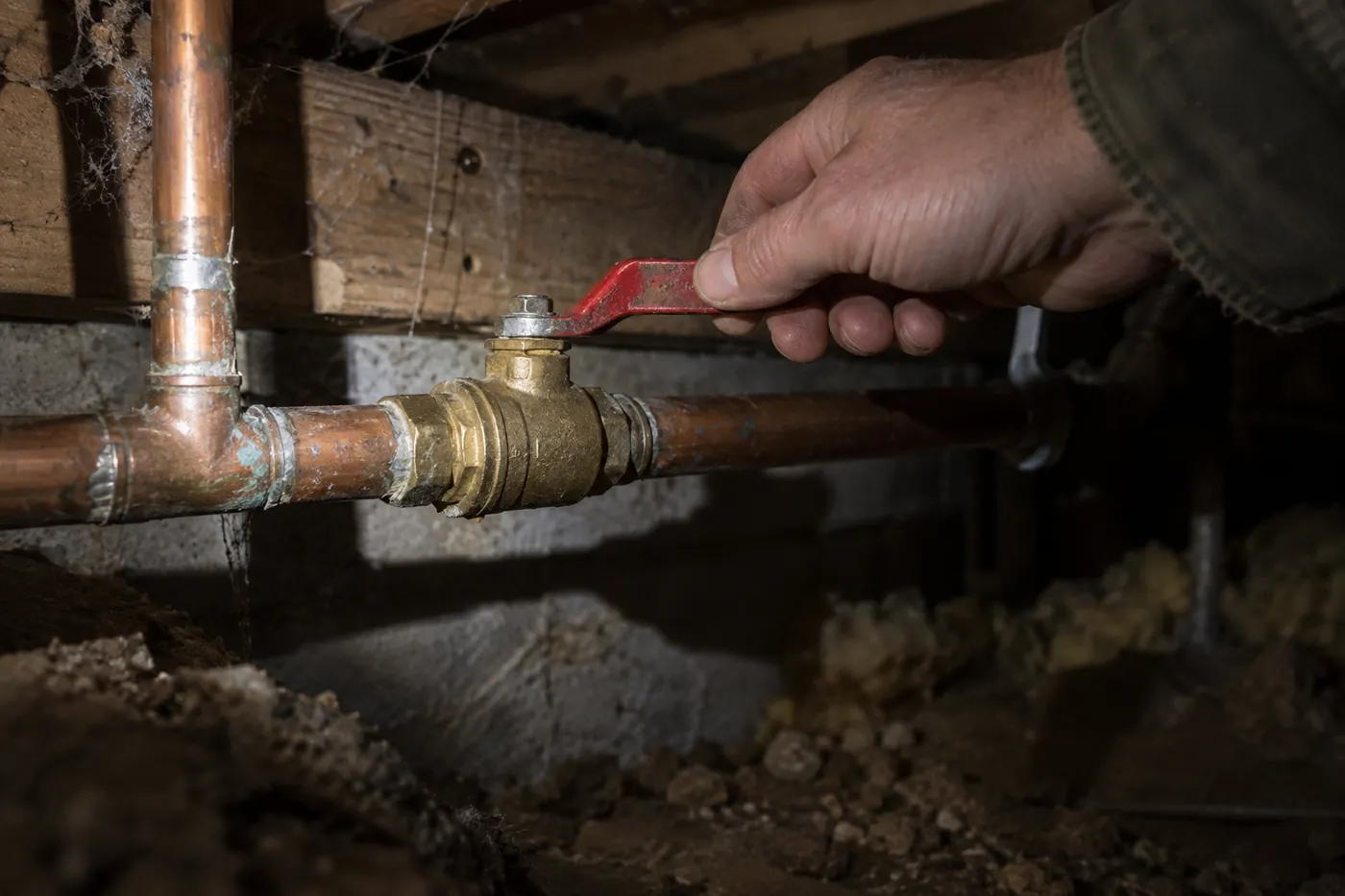
If it is a supply line, appliance, or water heater — shut off the fixture valve first if you can reach it. If it will not close or you cannot get to it, go to the main.
Where the main shutoff is in Greenville housing:
If you cannot find it, go to the street. There is a meter box near the property line, usually a rectangular lid at grade. The valve inside sits on the street side of the meter and takes a meter key or a pair of long-handled pliers. Greenville Water can also shut service off at the meter.
If it is coming from outside — storm water, a neighbor's overflow, a rising creek — there is no valve. Skip to protecting yourself and move to higher ground in the house.
If it is coming up through a drain, stop using every water fixture in the house immediately. Every flush and every sink adds to what is coming back up.
This is the part worth slowing down for.
Do not walk into standing water in a room where outlets, cords, or appliances are submerged or partially submerged. Kill power to that area at the breaker panel first — if the panel itself is dry and you can reach it without crossing the water.
If the panel is in the wet area, or the water is deep, or you are not sure, call the utility and stay out. A room of carpet is not worth the risk, and a restoration crew will not enter it either until it is de-energized.
Ceiling leaks carry the same issue. Water traveling through a ceiling reaches junction boxes and light fixtures. If a light fixture is dripping, the circuit is wet.
Three levels, and they change what you should do:
Clean — a supply line, a water heater, an ice maker, a bathtub that overflowed with clean water. You can work in it. Boots are still a good idea.
Gray — dishwasher or washing machine discharge, a toilet overflow with no solids, an aquarium, or any clean water that has sat more than a day. Gloves, boots, and do not let kids or pets in.
Black — sewage, a backed-up drain, or water that came in from outside across the ground. Do not clean this yourself. It carries bacteria and whatever it crossed on the way in, and the correct response is removal of porous materials, not mopping. Our sewage cleanup page explains why.
If you are not sure which one you have, treat it as the worse one.
This is fifteen minutes that can be worth thousands.
Photograph and video the whole scene before touching it. Wide shots of each room showing water extent, then close shots of the damage.
Photograph the failure itself. The split hose, the cracked fitting, the ruptured tank, the stain on the ceiling directly under the source. This is the single most valuable photo in your claim, because it establishes cause of loss.
Do not throw the failed part away. Put the burst hose in a bag and keep it. An adjuster who can see the failure mode approves faster than one reading a description.
Get serial numbers and model numbers off any appliance or electronics that got wet, before they go in a pile.
Note the time. Date of discovery matters, and you will be asked.
Then, and only then, start moving things.
Call the restoration company and your insurer the same day. The order between them matters less than people think — what matters is that neither one waits on the other.
Your policy contains a duty to mitigate. You are required to take reasonable steps to limit further damage. Sitting on a wet house for two days waiting for an adjuster to authorize drying is exactly what that clause is written against, and the additional damage from those two days can land on you.
If you rent, notify the landlord or property manager in writing the same day — text or email, so there is a timestamp. Your renter's policy covers your belongings; the building is theirs. See rental property water damage.
If you are in a condo or apartment and the water is coming from a unit above you, notify management as well as your own insurer. There are two policies in play and they will need to talk to each other.
Move now: - Anything paper — documents, books, photographs. Paper is unrecoverable fast. - Electronics that are not yet wet. - Rugs, especially anything with dye that can bleed into carpet or wood. - Small furniture off wet flooring.
Lift, do not move: - Heavy furniture. Slide foil or plastic blocks under the legs to break contact with wet flooring. Wooden furniture legs on wet carpet will stain the carpet and wick water upward into the furniture.
Leave for the crew: - Anything heavy enough to hurt you on a wet floor. - Anything in a Category 3 area. - Soaked mattresses and upholstered furniture — they are far heavier wet than you expect.
A short list, and every item on it is something homeowners do with good intentions.
Do not run a household shop vac on contaminated water. It aerosolizes the contamination through the exhaust and puts it into the air of the whole house.
Do not point box fans at wet hardwood. Fast surface drying on wood causes the top face to shrink while the bottom stays wet, which is exactly how you get permanent damage. Water under hardwood floors covers this in full.
Do not turn the heat up to dry things out. Warm air holds more moisture, so without a dehumidifier removing it, you are just moving water from the floor into the air and then into the rest of the house.
Do not use bleach on wet building materials. It does not address moisture, it does not penetrate porous materials, and it adds water. The EPA's mold guidance does not recommend biocides for routine cleanup.
Do not tear out drywall before it is documented. Once it is in a dumpster, the evidence is gone.
Do not start pulling carpet up yourself if there is any chance of Category 2 or 3 water. And if it is clean water, the cushion underneath is the part that matters — see wet carpet drying.
So you know what a normal response looks like:
Extraction first. Standing water gets removed with truck-mount or portable extraction units, including weighted extraction across carpet, which pulls far more water out of cushion than a wet vac can.
Moisture mapping. Meters across affected and adjacent areas, plus an unaffected area of the same material to establish your house's dry standard. Often thermal imaging to find where water traveled inside walls.
Category and Class determined. Category decides what gets discarded. Class decides how much equipment and how long. Both get documented.
Controlled demolition, if needed. Baseboard off, carpet cushion out, inspection holes drilled, wet insulation removed.
Equipment set. Air movers positioned on a spacing calculation, dehumidifiers sized to the cubic footage and the Class.
If nobody takes a reading in your house on the first visit, that is not a restoration job — that is a cleanup.
Once equipment is set, your job is mostly to leave it alone.
It is loud. Air movers run at a constant pitch and there will be several of them. This is normal, and it runs around the clock.
Do not turn it off overnight. Every hour of downtime extends the job, and a stalled drying cycle is where microbial growth starts.
Keep windows and exterior doors closed. This is counterintuitive. In Greenville from roughly May through September, outdoor air is often more humid than the air the dehumidifier is producing inside. Opening windows undoes the work.
Keep the HVAC running unless the crew says otherwise. It helps circulate conditioned air.
Expect a daily visit with fresh readings. Ask to see the log.
This is the number the whole urgency is built on. Under favorable conditions — moisture, a cellulose food source like drywall paper or wood, and warmth — microbial growth commonly begins within 24 to 72 hours.
Greenville sits at the unfavorable end of that. Summer dew points here regularly run in the low 70s, which means indoor humidity climbs the moment the HVAC is not keeping up, and a wet house in August has everything growth needs.
That is the entire reason the response matters more than the repair. Dry it inside the window and you have a water loss. Miss the window and you have a water loss plus a mold remediation job on top of it.
Start a folder now. You will want it in six weeks.
Shut the water off. Kill power if anything electrical is wet. Decide if the water is safe to be near. Photograph everything before you touch it. Call your insurer and a restoration crew the same day. Lift furniture off wet floors. Leave the equipment running and the windows closed.
That is the whole first day. Everything after it is easier if that part went right.
If it is happening right now, start here: emergency water removal.
Sources and further reading: EPA — Mold and Moisture, CDC — Mold Cleanup After a Flood, Ready.gov — Floods, IICRC, Greenville Water
Shut off the water at the fixture valve or the main, then cut power to the affected area if anything electrical is wet. Photograph everything before you move anything, then call your insurer and a restoration company the same day.
Call them, but do not wait on them to begin mitigation. Policies require you to take reasonable steps to prevent further damage, and emergency mitigation is covered work. Document thoroughly so the scope is defensible.
Commonly 24 to 72 hours with the right moisture, temperature, and material. In a Greenville summer, plan on the short end.
Fans move air but do not remove moisture from it. Without dehumidification sized to the space, you are relocating water into the air and into other rooms. On hardwood, fans alone can cause permanent damage.
Usually not. From late spring through early fall, outdoor air in the Upstate is often more humid than what a dehumidifier is producing indoors. Keep the house closed while equipment runs.
Typically their policy covers the damage they caused, and yours covers your belongings while it is sorted out. Notify management and your own insurer the same day, in writing.