Everything in between is a judgment call made with a meter, not with your hand.
Homeowners tend to ask this question backwards. They look at how big the stain is. The stain tells you almost nothing. What matters is what kind of water it was, how long it sat, and what is inside the cavity behind it.
A sheet of drywall is a gypsum core sandwiched between two layers of paper. That construction is the whole story.
Gypsum itself is fairly tolerant of water. It gets soft when saturated, but as long as it has not lost structural integrity, it can often be dried and it returns to serviceable condition.
The paper is the problem. Paper is cellulose, and cellulose is food. Under the right moisture and temperature, mold colonizes paper facing quickly — the commonly cited window is 24 to 72 hours, and in a Greenville summer, you are at the fast end of it. The EPA's guidance on mold and moisture uses the same window.
So the real question is never "is the drywall wet?" It is "has the paper been wet long enough, and with what?"
This is Category, and it overrides everything else.
Category 1 — clean. A supply line, a water heater, a melting ice maker line. Sanitary at the source. Drywall can usually be dried in place if it is caught early and it has not lost integrity.
Category 2 — gray. Dishwasher or washing machine discharge, toilet overflow with no solids, a failed aquarium, water that has sat and picked up contamination. Drywall in the directly affected zone usually comes out. Some of it can be saved above the wet line.
Category 3 — black. Sewage, a backed-up drain line, floodwater from outside, or any Category 1 or 2 water that has sat long enough to become contaminated. Porous material goes. Drywall is porous. It is removed, not dried, regardless of how dry the meter says it is — because the issue is what soaked into it, not how wet it is. Our sewage cleanup page explains that decision.
Category is also not fixed. Clean water that sits for three days in a warm house is no longer clean water.
Under 24 hours with clean water: good odds. Two to three days: the paper is the question. Past that, in this climate, the safe assumption is that something has started, even when you cannot see it.
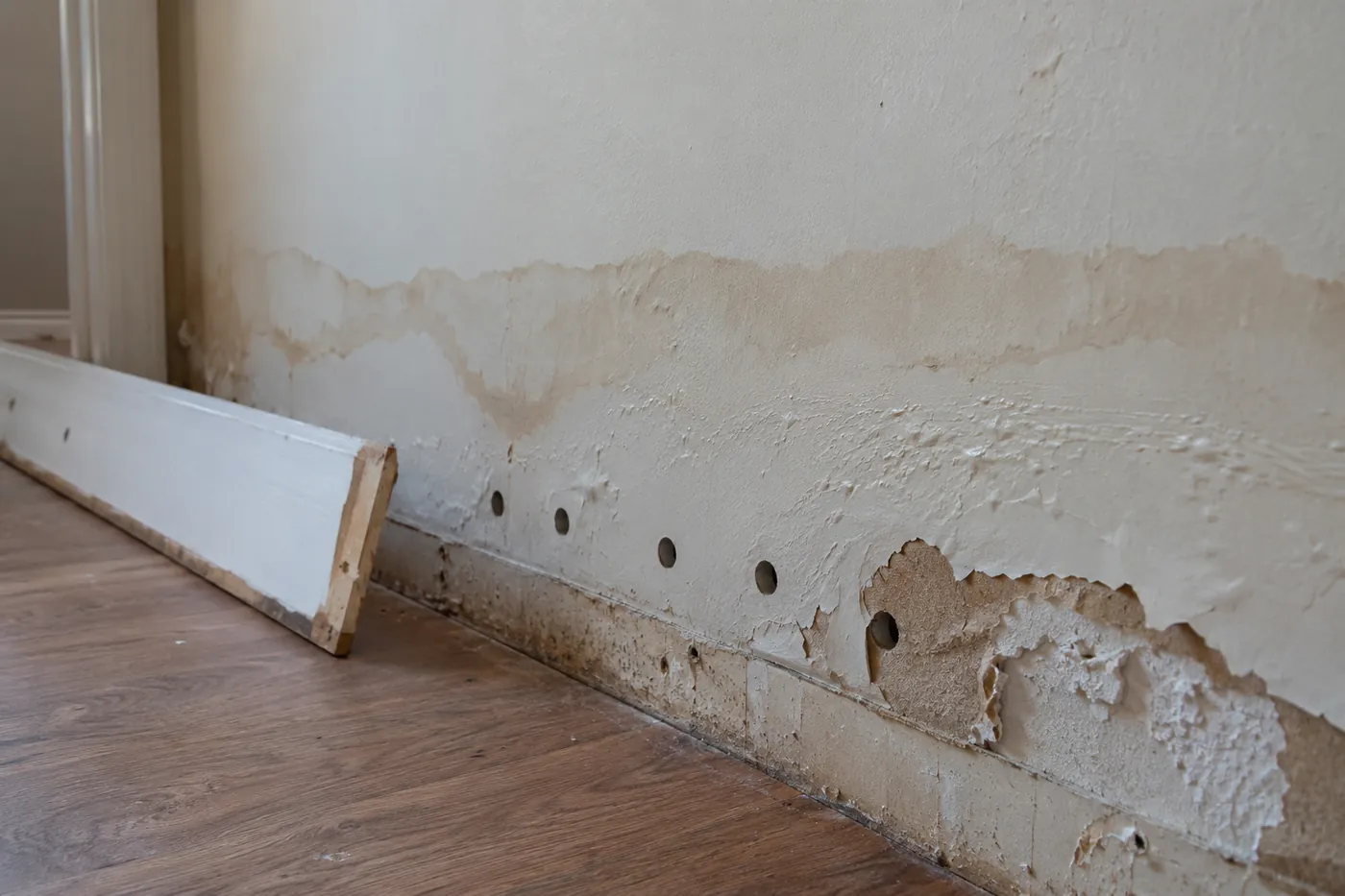
A stain that is already brown and ringed has been there a while. A stain that is dark, wet, and expanding is fresh.
This is the one people forget, and it is usually the tiebreaker.
Nothing behind it — an interior wall with an empty cavity — is the easy case. Open the cavity, move dry air through it, and the drywall dries from both faces.
Fiberglass insulation behind it changes the answer. Wet fiberglass holds water against both the drywall and the framing, dries extremely slowly in place, and loses most of its insulating value. On an exterior wall with saturated batts, the insulation comes out almost every time — and once you are opening the wall to pull the insulation, you have already removed the drywall.
Closed cell spray foam behind it is a different problem again. Water can get trapped between the foam and the drywall with nowhere to go.
A vapor barrier in the assembly can trap moisture on one side and stall the drying entirely.
When drywall does come out, it rarely comes out sheet by sheet. It gets cut in a horizontal line across the wall — the flood cut.
Two feet is the standard because standard drywall is 48 inches wide, so a cut at 24 inches is half a sheet and the replacement piece is a clean, cheap dimension. It is also above the typical wick height on a Class 2 loss.
Four feet gets used when the water wicked higher, when insulation above the wet line got soaked, or when the wall is going to be reinsulated anyway. It also lands on a factory edge, which produces a better finished seam than a cut edge.
The cut should be made above the highest wet reading, not at a convenient number. If the meter reads wet at 26 inches, the two-foot cut is wrong.
It is a real option, not a shortcut, and on the right loss it saves you the entire reconstruction cost.
The method:
Done properly this takes three to five days. Done improperly — a box fan pointed at a wall — it takes forever and hides a wet cavity behind a dry-looking surface. More on the equipment side on our structural drying page.
You can get a useful read without tools, and a much better one with a cheap meter.
Press the drywall firmly with your thumb. Sound drywall resists. Drywall that gives, dents, or feels spongy has lost integrity and is not coming back.
Look at the paper. Bubbling, peeling, or paper that separates from the core is a replace condition.
Check the tape joints. Joint compound and tape fail before the field of the sheet does. Cracked or lifting tape at a seam is a sign the assembly took on real water.
Look for a tide line — the horizontal stain that shows how high the water wicked. Then assume it went higher than that, because the meter usually finds moisture several inches above the visible line.
Use a pinless meter if you have one. Scan across the wall from a known dry area toward the wet one and watch where the reading climbs. Relative readings are more useful than absolute numbers on drywall.
Everything above applies to walls. Ceilings get judged more conservatively for one reason: gravity.
A wet ceiling holds the water plus the weight of wet insulation sitting on top of it, and drywall that has lost integrity overhead is a safety issue rather than a cosmetic one. Sagging, a visible bulge, or a wet area larger than a dinner plate on a ceiling is generally removed.
There is also almost always insulation involved on a ceiling below an attic, which pushes the answer toward removal on its own. See ceiling leak water damage.
A good portion of the older housing in Piedmont, downtown Fountain Inn, and the mill villages around Greenville is plaster over wood lath rather than drywall.
Plaster is usually worth saving. It has no paper facing, so the mold food source is different, and it is essentially irreplaceable with modern materials at a reasonable cost.
It also dries very slowly. Plaster is dense, and the wood lath behind it holds moisture. These jobs run into Class 4 territory and need low-humidity conditions rather than high airflow. Expect a week or more, and expect it to be worth the wait.
What kills plaster is not the water — it is the keys. The plaster pushed through the gaps in the lath and hardened into "keys" that hold the whole wall on. When those break, the plaster comes loose from the lath and no amount of drying brings it back. Tapping the wall and hearing a hollow, loose sound means the keys are gone in that area.
The comparison is not drying versus demolition. It is drying versus demolition plus everything demolition triggers.
Removing drywall means: removal and disposal, insulation replacement if it was wet, new drywall, tape, three coats of compound, texture matching, primer, and paint. Trim comes off and goes back on. The room is out of use longer than the drying would have taken.
And the finish will not match. Texture is the honest problem nobody mentions upfront. Orange peel, knockdown, and skip trowel are applied by hand, and a patch blends only so well. On a wall with a window or a corner nearby, a patch can be hidden. In the middle of a long wall in good light, you will see it, which means the real cost is painting corner to corner.
That is the argument for drying in place when the conditions actually allow it.
If water is still moving, none of this matters yet — stop the source and get the standing water out first. Emergency water removal covers the first few hours.
Sources and further reading: EPA — Mold and Moisture, CDC — Mold and Health, Gypsum Association, IICRC
Often, when the water was clean, it was caught within a day or two, the cavity behind it is empty or has been opened, and the material has not gone soft. Contaminated water or saturated insulation usually means removal.
Commonly 24 to 72 hours under the right temperature and humidity. In a warm, humid Greenville summer, assume the fast end of that window.
Standard drywall is 48 inches wide, so a cut at 24 inches uses exactly half a replacement sheet and lands above the typical wick height. The cut should always be above the highest wet reading, not at a fixed number.
Not necessarily. Check it for softness, bubbling paper, failed tape joints, and staining. If the material is firm and the cavity behind it dried too, it can stay. The risk is a cavity that never dried while the surface looked fine.
Moving air across a painted surface does very little, because paint slows vapor transfer. Effective drying gets dry air into the cavity and pulls the moisture out of the room with a dehumidifier. A fan alone usually spreads humidity rather than removing it.
Wet fiberglass holds water against the framing, dries very slowly, and loses most of its R-value. On an exterior wall it almost always comes out — and removing it means opening the wall anyway.