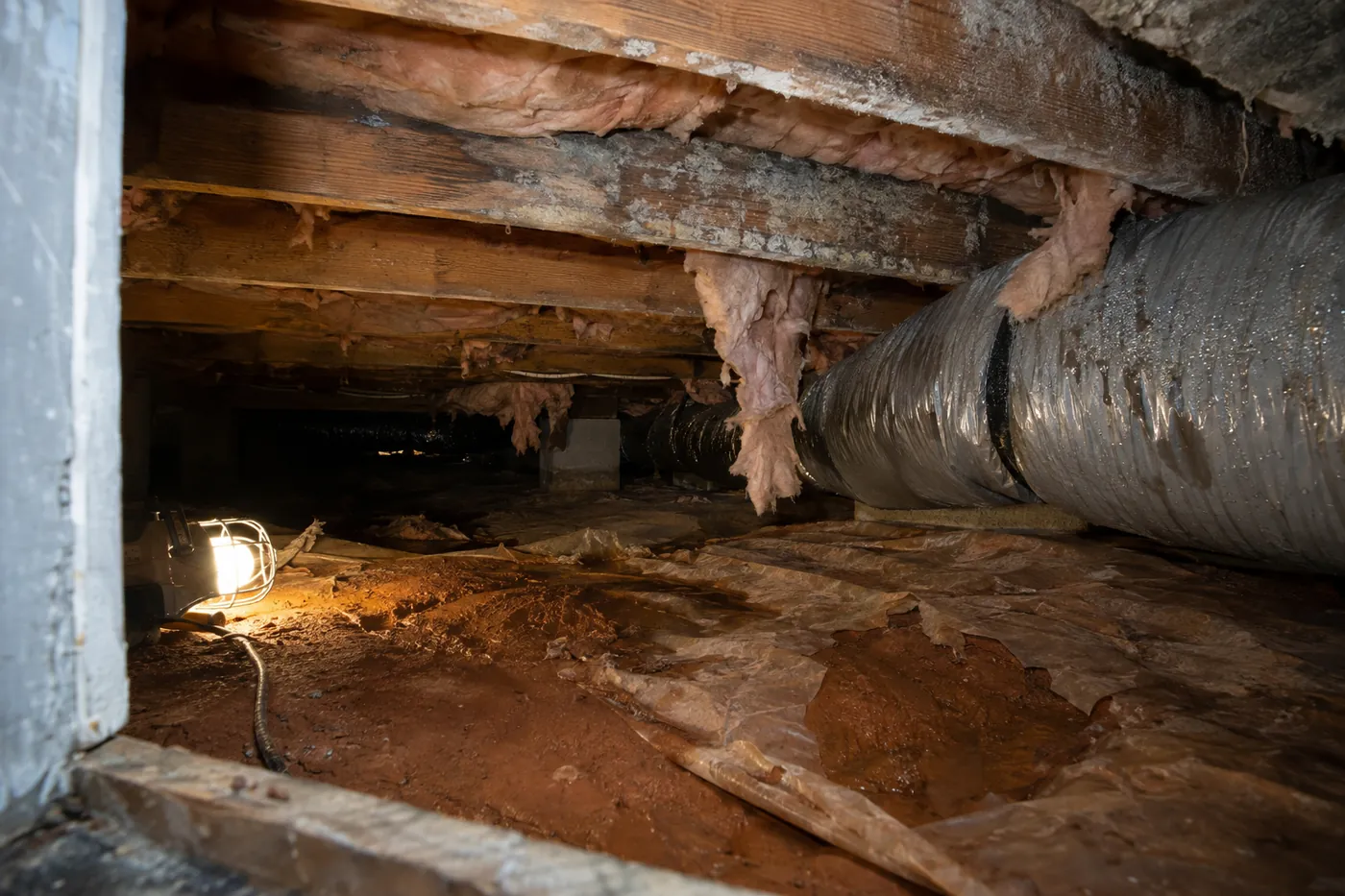
Almost always that is a moisture problem rather than a mold problem, and the difference matters, because you cannot spray your way out of a moisture problem.
The other thing worth knowing up front: if you can smell it in the house, you are breathing crawl space air. That is not a figure of speech. It is how a house moves air.
The musty, earthy, slightly sweet smell is not mold spores. Spores have almost no odor.
What you smell are microbial volatile organic compounds — gases released by mold and bacteria as they digest wood, paper, and dust. They are small, light molecules, they travel easily, and your nose detects them at very low concentrations. That is why a crawl space can smell strongly long before there is anything visible on the joists.
Practical translation: the smell is an early warning, not a late one. It shows up before the staining does.
Houses breathe upward. Warm air rises and escapes at the top of the building through the attic, recessed lights, and gaps around plumbing and wiring. Air has to come in somewhere to replace it, and the easiest place is the bottom — through the crawl space, up through the subfloor, around plumbing penetrations, and through the gaps at the band joist.
This is the stack effect, and it runs if or not you have any obvious holes. Commonly cited estimates put a substantial share of the air on your first floor — often quoted as high as half — as air that came up from the crawl space first.
So a crawl space is not an outdoor area under your house. It is the bottom of your air supply. Anything growing down there is being sampled by the rooms above it all day. The U.S. Department of Energy's Building America guidance covers why crawl spaces get treated as part of the conditioned envelope in humid climates.
The most common cause by a wide margin, and the least dramatic.
Soil is wet. It releases water vapor continuously — a typical crawl space floor can put a meaningful volume of water into the air every single day through evaporation alone. There is no leak, no event, and nothing to point at. The ground is just doing what ground does.
Red clay soil across Greenville County holds water well and drains slowly, which makes this worse here than in sandier parts of the state.
What you will see: a dirt floor with no plastic, or plastic that is torn, has gaps at the seams, or stops short of the foundation walls. Insulation batts sagging or on the ground. A general dampness with no identifiable source.
Grading that slopes toward the house. Downspouts that dump at the foundation instead of being carried away. A missing or clogged footing drain. A neighbor's yard draining onto yours.
What you will see: staining or mud lines on the foundation walls, standing water or soft soil at one end, worse conditions after heavy rain, efflorescence — the white chalky bloom — on block or brick.
This one is fixable with drainage work, and it has to be fixed before anything else is worth doing.
Supply lines, drain lines, and water heater pans all live down there, and a slow failure can run for a very long time before anything appears upstairs.
What you will see: the damp area is localized rather than general. Wet soil under one specific spot. Corrosion or mineral staining on a fitting. A water bill that crept up. In an older home, gray polybutylene supply lines are a common culprit — see polybutylene pipe leaks.
The tell that separates this from humidity: a leak makes one area much wetter than the rest. Humidity makes everything uniformly damp.
Cold surfaces in humid air produce liquid water. Your AC ductwork runs at roughly 55°F in the summer. Crawl space air in August can easily carry a dew point above 70°F.
Every time that air touches the duct, water condenses on it — the same way a glass of iced tea sweats on a porch. Wet duct insulation, drips onto the joists below, and a steady supply of moisture for the entire cooling season.
What you will see: wet or stained duct wrap, drip marks on the joists directly below duct runs, a damp area that follows the HVAC lines rather than the plumbing lines.
Related: the condensate line itself can overflow and add to it. See AC condensate line leaks.
For most of the last century, the standard advice was that crawl space vents should be open in summer to let the space "breathe."
In a humid climate that advice is backwards, and the physics are not complicated.
Here is what happens on a July afternoon in Greenville. Outdoor air is 90°F with a dew point around 73°F. Your crawl space surfaces — the soil, the block walls, the ductwork, the bottom of the subfloor — sit somewhere around 68 to 72°F, because the ground keeps them cool.
Open the vents, and you invite 73°F dew point air onto 68°F surfaces. Air cannot hold its moisture below its dew point. The water comes out of the air and onto your framing. Every hour, all summer.
Ventilating a cool crawl space with warm humid air does not dry it. It is a humidification system with the label on backwards.
This is why so many Greenville crawl spaces smell worst in late summer and improve in winter, with no leak anywhere.
Bring a flashlight, and wear something you will throw away.
Take a humidity reading. A cheap hygrometer is enough. Anything sustained above 60% relative humidity is a problem. Above 70% is active growth conditions. Leave it down there for an hour rather than reading it the instant you walk in.
Look at the ground. Bare soil, or plastic? If there is plastic, does it reach the walls, are the seams lapped, is it torn?
Look at the insulation. Fiberglass batts hanging down, falling out, or dark and matted have been wet. Insulation that has fallen onto the ground is doing nothing except holding moisture.
Look at the joist ends and the band joist where the framing meets the foundation. This is where growth shows first — a gray, white, or black bloom on the wood, often fuzzy rather than flat.
Check the wood moisture content if you have a pin meter. Above 20% supports growth. Sound, dry framing should read in the low teens.
Follow the smell. If it is strongest in one corner, you are looking for a leak. If it is the same everywhere, you are looking at humidity.
Look for the obvious extras: standing water, mud, animal activity, a torn duct, a dripping pipe.
The order matters more than the individual items. Doing them out of sequence wastes money.
1. Stop liquid water first. Fix the plumbing leak. Fix the grading. Extend the downspouts ten feet from the foundation. Install a drain and sump if groundwater is coming in. Nothing else works until this is done.
2. Cover the ground. A heavy vapor barrier across the entire floor, up the foundation walls, sealed at seams and edges. This alone removes the largest single moisture source in most crawl spaces.
3. Close the vents and seal the envelope. Once the ground is covered, the vents are no longer a benefit — they are the humidity supply. Seal them, air-seal the band joist, and insulate the walls rather than the floor above.
4. Add dehumidification. A dedicated crawl space dehumidifier that drains to daylight or a pump, sized for the space, holding the area under 60%. Not a bathroom dehumidifier with a bucket somebody has to empty.
5. Then, and only then, deal with what is already growing. Remediate the affected wood surfaces. Doing this step first is the most common and most expensive mistake — the growth comes back in a season because nothing changed about why it was there.
Our crawl space water damage page covers what the work involves when there is an active water source, and mold remediation covers the treatment of affected material.
Fogging or spraying. Whatever is applied treats the surface it lands on, on the day it lands. It changes nothing about humidity. The growth returns.
Mold-resistant or encapsulating paint on the joists. Same problem. It buries the issue and makes future inspection harder.
A bag or tub of moisture absorber. These pull a few ounces of water. Your crawl space floor is evaporating gallons.
Opening the vents wider. Covered above. It is the opposite of a fix in this climate.
A single ordinary fan. Moving humid air around a crawl space redistributes it. It does not remove it.
Four signs that point at a leak rather than a general moisture problem:
A leak in the crawl space also tends to show up in the water bill, which is worth pulling before you call anyone.
Crawl space moisture does not stay in the crawl space. It moves up through the subfloor into whatever is on top of it.
The most common result is hardwood flooring that cups — the edges of each board rise above the center — with no leak anywhere in the house. It happens because the underside of the wood is absorbing moisture from below while the finished top face stays comparatively dry. It appears in late summer and can partly relax in winter as the crawl space dries out.
If your floors have started cupping and nothing spilled, look under the house before you call a flooring contractor. Water under hardwood floors covers what is reversible and what is not.
Sagging or springy floors, and doors that stick seasonally, can come from the same source — framing that has been at elevated moisture content long enough to move.
The smell means moisture has been sitting long enough for growth. In Greenville, the cause is usually one of three things: an uncovered dirt floor, water coming in from outside, or open vents pulling humid summer air onto cool surfaces.
Fix the water, cover the ground, close the vents, add a dehumidifier, then treat what grew. In that order.
Treating the growth first and skipping the moisture is how people pay for the same job twice.
Sources and further reading: EPA — Mold and Moisture, CDC — Mold, U.S. Department of Energy — Energy Saver, IICRC
Because open foundation vents let warm, humid summer air onto cool crawl space surfaces, where it condenses. Winter air is drier and the surfaces are relatively warmer, so condensation stops and the space partially dries out.
The smell itself is microbial gases, not spores. But it indicates active growth, and because air moves upward from the crawl space into the living space, occupants are breathing whatever is down there. It is a reason to investigate rather than to panic.
Below 60% relative humidity on a sustained basis. Above that, conditions support microbial growth. Above 70% it is close to guaranteed.
In a humid climate, open vents typically add moisture rather than remove it during the cooling season. The current approach is to seal the ground with a vapor barrier, close the vents, and control humidity mechanically.
Only after liquid water is stopped and the ground is covered. A dehumidifier running against bare soil and an active leak will run constantly and still lose.
Yes. Moisture moving up through the subfloor is a frequent cause of seasonal cupping in hardwood, with no leak anywhere in the living space.