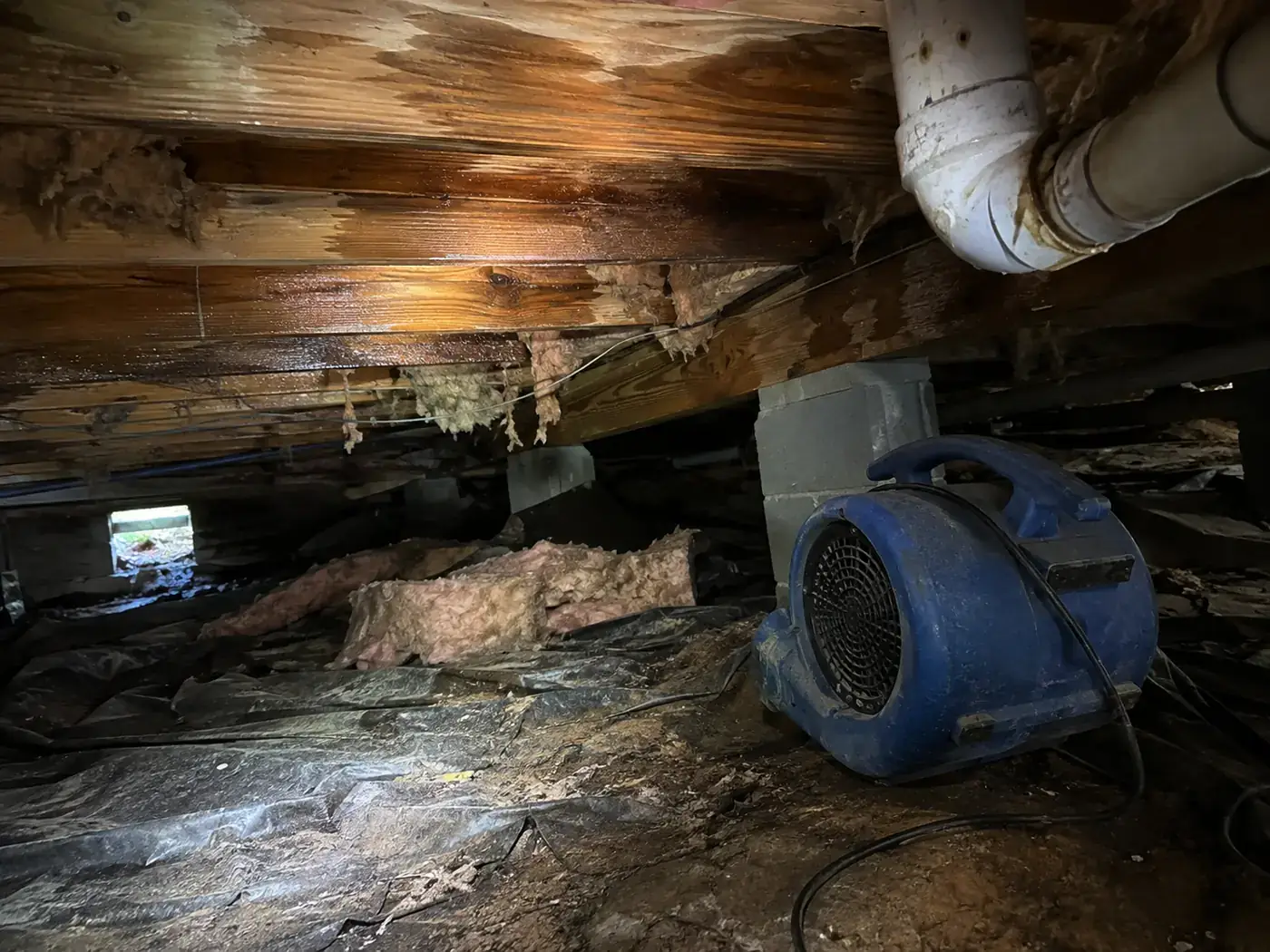
Extraction and structural drying across Taylors, where mid-century ranch housing on crawl spaces makes up much of the stock and changes where the water ends up.
(864) 515-4097 Call nowWater damage gets more expensive by the hour. Lines are answered at any time, including nights, weekends and holidays.
(864) 515-4097Useful to have ready, though none of it is required:
Taylors is in large part a mid-century suburb. Much of it went up between the 1950s and the 1970s as the mill village around the old Southern Bleachery gave way to subdivisions, and most of that housing sits on a crawl space.
In Taylors more than in most of the areas we cover, a water loss commonly ends up under the house. A failed supply line on the main floor runs to the lowest point it can find, soaks through the subfloor, and saturates the batt insulation stapled beneath it. That insulation then lets go and falls, which is often the only visible sign anything happened.
The problem with a crawl space is that it does none of the drying for you. It is dark, unventilated, sits at high humidity through the Upstate summer, and nobody looks in it. Wood down there stays wet for weeks after the floor above feels completely dry underfoot. Any Taylors loss gets inspected from underneath as a matter of course, not as an extra.
Houses of this age often still carry some original supply plumbing, and many have ductwork running through the crawl space. Wet ducts are their own problem: they distribute damp air through the whole house every time the system runs, which spreads a localized moisture problem into rooms that were never touched by the water.
Plaster, solid hardwood over plank subfloor, and particleboard cabinetry from the period all respond badly to water and respond quickly. The window for drying in place rather than removing and replacing is shorter here than in newer construction.
Calling costs nothing, and you will get an honest answer about the need for a crew and what you can safely handle yourself.
(864) 515-4097All of Taylors, including Wade Hampton, Brushy Creek, Paris Mountain and the streets around Taylors Mill.
For most Taylors losses, yes. If the house is on a crawl space and water reached the floor, the assumption is that some of it went through. Inspecting from the room above tells you very little about what the joists and subfloor are holding.
It usually means the insulation got wet at some point, which is either a plumbing failure, a long-running leak, or a crawl space humidity problem. All three need finding. Fallen insulation is a symptom, not the cause, and replacing it without fixing the source puts you back in the same place.
It depends on what the duct is made of and what kind of water reached it. Sheet metal can often be cleaned and dried. Flex duct with wet insulation, or any duct that took contaminated water, generally gets replaced rather than dried.