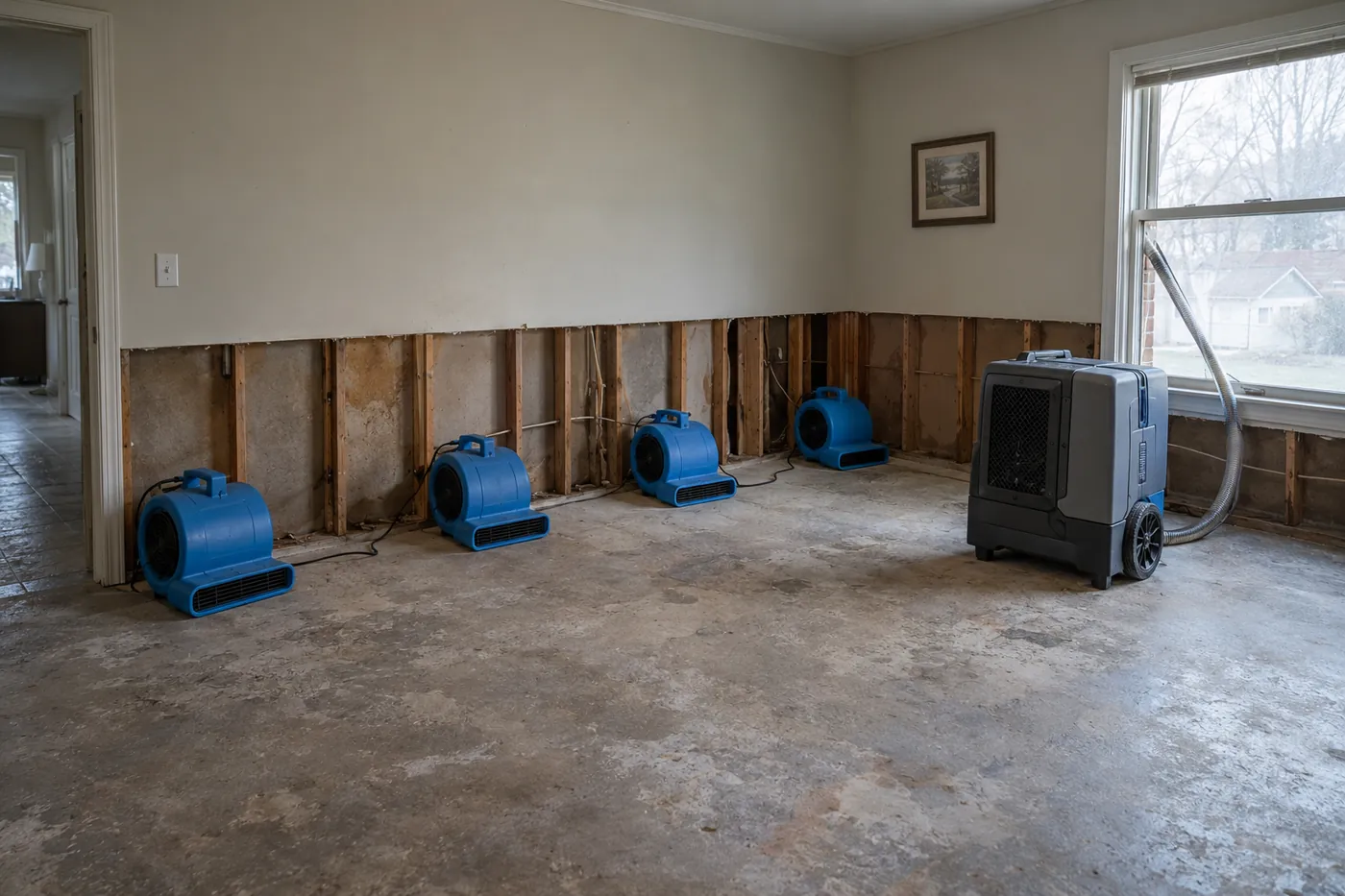
Class is the number that decides how many machines end up in your living room and how many days they run. It is not the same thing as Category, which describes how dirty the water is — and mixing the two up is the most common misunderstanding in this whole industry.
Almost every restoration site explains Category. Very few explain Class. Class is the one that shows up on your invoice.
Think of it this way. Category answers "what is in the water?" Class answers "how much material did it soak?"
| What it measures | What it changes | |
|---|---|---|
| Category 1, 2, 3 | Contamination level | What gets thrown away |
| Class 1, 2, 3, 4 | Amount and type of wet material | How much equipment, how many days |
A clean supply line failure that wet one closet is Category 1, Class 1. A sewer backup across a finished basement is Category 3, Class 2 or 3. They are independent readings, and a job carries both.
Both come from the same document — the IICRC S500 standard, which is the reference most legitimate restoration firms and most insurance adjusters work from.
Less than about 5% of the combined floor, wall, and ceiling surface in the affected space holds moisture. Water touched mostly hard, non-porous surfaces. Little or no wet carpet and cushion.
What this looks like in a real house: a toilet supply line let go in a half bath with tile floor, and someone caught it within an hour. The tile is wet, maybe the vanity toe kick, maybe two feet of the baseboard.
What to expect: a couple of air movers, one dehumidifier, two or three days. This is the class where a homeowner sometimes reasonably handles it alone — though "reasonably" means you actually have a moisture meter, not that the floor feels dry to your hand.
Roughly 5% to 40% of the surfaces are wet. Water spread across an entire room. Carpet and cushion are saturated. Moisture has wicked up the drywall, typically under 24 inches.
This is the most common residential loss we see. A washing machine hose fails, or a water heater lets go in a utility closet, and by the time anyone notices, the water has run across the floor and found the walls.
The important detail people miss: drywall wicks upward. Water hits the bottom plate and climbs through the gypsum core by capillary action. The paint on the surface can look perfectly normal at 18 inches while the material behind it reads wet. That is why baseboards come off and why small inspection holes get drilled — not to create work, but to reach the cavity.
What to expect: several air movers, a larger dehumidifier, three to five days, and likely the removal of carpet cushion. Carpet itself is often salvageable on a clean loss. See wet carpet drying for how that decision is made.
More than about 40% of the surfaces are wet, and the water came from overhead. Ceilings, walls, insulation, and subfloor are all in play.
Gravity is the difference. A supply line that fails in an attic or on a second floor does not spread across a floor — it saturates everything on the way down. Ceiling drywall, the insulation sitting on it, the top plates, both faces of the walls below, and then the floor.
Wet insulation is the hidden cost here. Fiberglass loses most of its R-value when it is wet, holds water against the framing, and dries very slowly in place. On most Class 3 jobs it comes out rather than getting dried.
What to expect: heavy equipment count, ceiling sections removed, five to seven days or more. Our ceiling leak water damage page walks through what happens when the water is coming down rather than across.
Class 4 is not about how much is wet. It is about what is wet.
Some materials hold water in a way that ordinary air movement will not pull out. The moisture is bound inside dense, low-porosity material, and getting it out requires low humidity, sometimes low pressure, and a lot more time.
Materials that put a job into Class 4:
The equipment changes. Instead of just air movers and a refrigerant dehumidifier, a Class 4 job typically brings desiccant dehumidification — which can drive a space far drier than a refrigerant unit — plus mat drying systems or injection drying that push dry air directly into the floor assembly or wall cavity rather than across its surface.
What to expect: 7 to 14 days, sometimes longer. This is the part homeowners push back on hardest, and it is the part where pushing back causes permanent damage. A hardwood floor that gets sanded before it reaches equilibrium will change shape again after it is refinished. If your loss involves wood floors, read what can actually be saved before you let anyone schedule a sanding date.
Mitigation is not priced by the hour or by the square foot of house. It is priced largely by equipment on site, per day.
The calculation runs roughly like this:
Air movers are placed on a spacing rule — roughly one per affected wall area plus one per corner, with adjustments. Dehumidifier capacity is calculated in pints per day against the cubic footage and the Class. This is why two houses with the same size loss can produce very different invoices: one was Class 2 carpet, the other was Class 4 hardwood over a crawl space.
Class drives equipment. Equipment drives days. Days drive the invoice. That is the whole chain.
It is measured, not guessed. On a properly run job:
If nobody takes a reading in your house on day three, nobody knows what is happening inside your walls. Ask for the log. Structural drying covers the process in more detail.
This is normal and it is not a bait-and-switch.
Upward: water is found in a cavity nobody knew about, or a hardwood floor that was hoped to be Class 3 turns out to be holding bound moisture. More equipment gets added.
Downward: the structure dries faster than projected and equipment comes out early. On an honest job this reduces your bill, because equipment is billed per unit per day.
What you want to see is the daily log showing the readings that justified the change. What you do not want is the same equipment sitting for eight days with no readings to explain why.
Local construction pushes losses toward particular classes more often than you would expect.
Vented crawl spaces are everywhere in older Greenville County housing. A loss that involves the crawl space brings in wet framing, wet insulation, dirt, and poor air exchange — often Class 4 conditions even when the water volume was small. See crawl space water damage.
Post-2000 slab construction in Powdersville, Simpsonville, and the newer Greer subdivisions puts concrete in the assembly. Water under luxury vinyl plank on a slab is a classic Class 4 problem — the surface looks fine, the slab underneath is holding water, and the moisture has nowhere to go but up.
Mill-era plaster in Piedmont and downtown Fountain Inn is dense, slow-drying, and worth saving. Plaster jobs run long.
Two-story homes with attic supply runs produce the Class 3 losses — a line fails up high and the water arrives everywhere below it.
A crew that answers all five without hesitating is working from the standard. A crew that cannot is guessing, and you are paying for the guess.
Category tells you what gets thrown away. Class tells you what it costs to dry what stays.
Class 1 is a closet. Class 2 is a room with wet carpet and walls. Class 3 is water from above soaking everything below it. Class 4 is hardwood, plaster, or concrete that will not give the water up quickly.
The more you understand which one you are in, the better you can judge an estimate — and the easier it is to tell a properly scoped job from an overloaded one.
If you are in the middle of a loss right now, start with emergency water removal. The Class can be determined once the standing water is gone.
Sources and further reading: IICRC — Institute of Inspection, Cleaning and Restoration Certification, EPA — Mold and Moisture, CDC — Mold
Category describes contamination — how clean or dirty the water is — and determines what materials get discarded. Class describes how much material is wet and how difficult it will be to dry, which determines equipment and time.
Class 4. It requires specialty equipment such as desiccant dehumidifiers and mat or injection drying systems, and it runs the longest, often 7 to 14 days.
Yes. If moisture is found in hardwood, plaster, or concrete that was not identified on day one, the drying approach changes and the Class is reassessed.
It depends on the affected wall and floor area, not on room count. The S500 standard sets the spacing calculation. Ask your contractor to show you the math for your specific job.
Class 1 is typically two to three days, Class 2 three to five, Class 3 five to seven, and Class 4 seven to fourteen. The real answer is: until the affected materials match the dry standard taken from an unaffected area of your own house.
Yes, continuously. Turning air movers off overnight because they are loud adds days to the job and raises the risk of microbial growth. Our mold remediation page covers what happens when drying stalls.